This is a project on using 123D Catch to get a 3D scan of my whole body. Once I had the scan I cleaned it up and manipulated it ready for 123D Make. I sliced the model in Make and preped it for Laser cutting. Once done I lazer cut and integrated the componentry and Arduino to make the head turn. I created two functions an automatic tracking function and a manually controlled function through Max MSP. In a way this is a Modern Day Puppet.
I struggled with this project from the beginning because the prompt allowed to make “anything.” Too many possibilities? I decided I wanted to make a lamp because the lights in my bedroom can only be controlled from the living room…oh, how I longed to have a light that I could switch on and off while lying in bed.
Inspiration, then success, then failure…
I wanted to create a lamp that responded to motion. The design of my lamp would allow the lights to fade in and out if it sensed motion. I used a tilt switch for motion sensing, a 4-pin switch for on/off capability and Tip 120 for using the Voltage In. After much “circuiting”, I got the lights to work exactly like I wanted, yay!
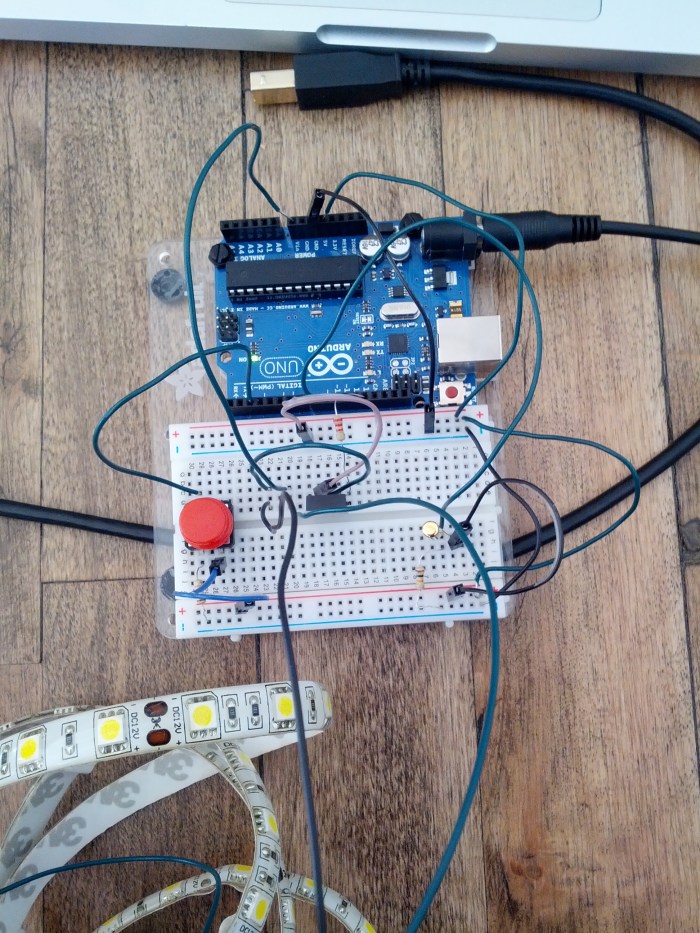
I was going to use a Leonardo Ardunio that would attach to my lamp and I soldered the many wires together. The tilt switch was to be connected to the one of the brass rods that would hang from the lamp. So, I proceed to create the mess you see below:
…but then a lamp!
I realized later that I created a short circuit and managed to kill my Arduino, but I decided to make my lamp anyway, and it does work like other lamps, so it won’t fade, but it will give you light when you want. Here it is:
It’s inspired by fall and each of the big maple leaves are personalized with elements of my life. I used the CNC to cut out the shelf piece which plays the “tree branch” and I used the laser cutter to make the leaves.
In developing this project, I wanted to combine RFID tag technology and RGB LEDs into a fun and delightful experience. When I decided on creating a messenger bag with a reactive front panel, I knew that it would have a very functional aspect too.
Some of my inspiration came from ET (Everything is a Toy) and the Reading Glove. Both show unique ways of using RFID tags in electronics, one for fun and one for education.
I worked with two strips of RGB LEDs to create a 7 by 7 LED matrix. After getting them up and running, I added in the RFID reader. Although I did not find a specific precedence combining these two elements, I did use this tutorial for the RGB LED set-up and this tutorial for the RFID code.
After the code was up and running, I soldered together a Boarduino for the brains of my final bag, and attached my RFID reader to it.
I designed a messenger bag with extra space in the front flap and back panel to accommodate one inch-thick foam to diffuse the light and protect the electronics, respectively. I put a zipper on the back panel to allow access to the electronics and to the battery pack.
I also created useful pockets, an adjustable strap, and magnetic snaps to hold the LED panel in place.
I laser cut a front panel out of wood to hold the LEDs in place. Above is the final set up for the front flap and back panel. And below is my final bag!
These pictures show the final, fully functional bag. This video shows my process and end result!
These are the RestPhones. They are essentially two pillows that sit on your head like headphones and allow you to comfortably listen to earbuds while resting your head. They’re great for watching movies in bed when you want to use earbuds, or for falling asleep to music on the bus.
The construction is simple. Some (imitation) leather and velvet for the body, foam for the cushion, and some bent aluminium for the band. I initially had some difficulty getting them to sit right, but by the third construction I was happy with the look and feel.
For my final project, I experimented with Persistence of Vision (POV) using the Adafruit MiniPOV3 kit. Here are a few photos of me soldering the boards.
My original idea was to embed these LEDs into sleeves of clothing so when one waves their arms, words would appear in air. After coding the PCBs & furiously waving my arms, I realized this may not be the best application. I attached the PCB to a stick & waved it for a photo. It displayed a word, but it was forward & backward. I also attached them to the inside of an umbrella, which was mildly successful.
Eventually I concluded that nunchucks would be a great application for the POV boards. I created a quick prototype before creating the final nunchucks.
When a ninja encounters a confrontation, he/she can choose to display a good or bad message depending on their mood & situation. One nunchuck is light toned (good message) & one nunchuck is dark toned (bad message). This is an epic tale of a hero & his external as well as internal struggles of what is good & what is bad.
I decided to go back to my original concept of making LED Jump Rope after trying few things. I looked at existing LED Jump Ropes and thought that I can make something with less colors that are beautiful to look without too much distraction. Here are couples of examples I looked at. The first photo is a typical LED jump rope for children. The 2nd photo is a jump rope with LED handles. The 3rd one is jump rope in action.
Can you believe the speaker pillow on the right costs almost $500? And the one on the left has a worse speaker than may cell phone from 2005. Pillowmakers, make pillows, leave the HQ music to the pros.
Risk #2: Take yourself too seriously
Changing behaviors is a natural part of being a designer, but that doesn’t mean I won’t laugh at you if you walk in wearing a ponchillo.
Risk 3: Make it do everything
It does everything? Really? Just what I was hoping for, a pillow with more functionality! My pillows at home are sooooo booooring.
YES: Be honest and playful
It’s what follows the “Ahh” or “Haha” that really counts: “Ahh, that makes so much sense” vs. “Ahh, I would never use that” or “Haha, that is so cute” vs. “Haha, what a kitchy piece of junk” is all the difference in the world.